
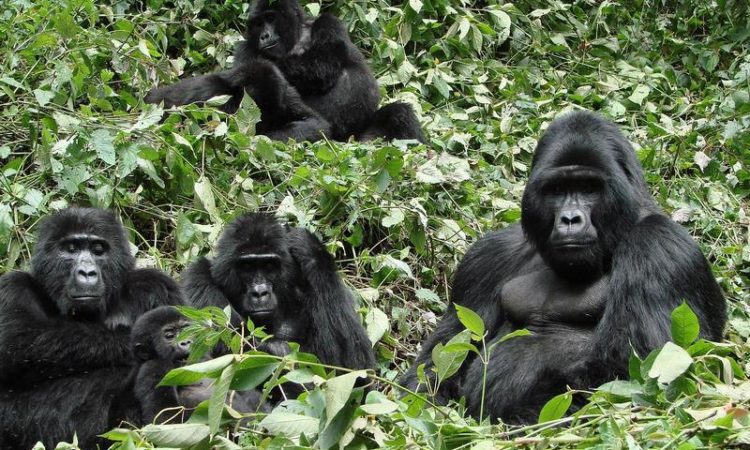
Do Mountain Gorillas Live in families?
Do mountain gorillas live in families?
Do mountain gorillas live in families? Mountain gorillas are giant wild and intelligent animals that are an endangered species, sharing 98% DNA with human beings; that’s why they are called the human cousins. Gorillas have two types of species: the ‘lowland gorillas’ and ‘mountain gorillas.’
The lowland gorillas are found in captivity, i.e., ‘zoos,’ while the mountain gorillas are found in the central part of Africa.
In the country of Uganda, they are found in Bwindi Impenetrable Forest National Park and Mgahinga National Park. Rwanda and the Democratic Republic of Congo. In the Virunga, gorillas are shy and social apes living in a group called a troop: The size of harems is very variable and includes 30-60 members of the family.
The biggest family of gorillas was found in Rwanda, which consisted of 65 members.
One silverback male is an adult gorilla, which is mature enough to lead a family with several adult females and their young ones. However, mountain gorillas contain 40% of several adult males who are closely related.
The family ‘troop’ contains more females than males; that’s why males fight for power.
The family of mountain gorillas carries out its day-to-day life by roaming in the forest, playing, feeding, and grooming their young ones.

When the silverback dies, the group finds a new leader, usually the eldest son of the dead leader, who takes over power.
The way mountain gorillas form a group, the females leave another family before reproducing at the age of 8-10 years; the first family is where the female reproduces because it’s her permanent family, although late arrivals are not considered the benefits of high ranking.
While a male gorilla is separated from his parents due to lack of breeding opportunities, he will remain solitary until he forms his own family. This process takes several years and begins when the male separates himself from his parents to go and form his own family and offspring.
In Uganda we have 12 mountain groups where gorillas live in families, including the family of Mgahinga National Park.
These families are located in the four sectors of Bwindi Impenetrable National Park; in the Rushaga sector we have 5 gorilla families, including Bweza, Nshongi, Kahungye, Busingye, and Mishaya.
In Ruhija we have families including Bitukura, Oru Zongo, and Kya Guriro; in the Buhoma sector there are 3 families, including Rushegura, Habinyanja, and Mubare, while in Nkuringo we have only one family, which is the Nkuringo, and the last group is found in Mgahinga National Park, called the Nyakagezi.
This gives it the whole answer that mountain gorillas live in families.